


Happy Friday!
There’s something special about youth baseball.
The smell of freshly cut grass. The sound of a ball hitting a bat. The excitement of a kid getting that first big hit. The friendships formed in dugouts and the memories made during long weekends at the ballpark.
For families, baseball can become much more than a sport.
It’s a community. It’s an education in teamwork, perseverance, and competition. And for some kids, it’s the beginning of a lifelong passion.
But there’s another side to youth baseball that deserves attention.
It’s become a significant business.
And the economics behind that business are changing how families experience the game.
I recently explored this in a Run The Money article called The $10,000 Little Leaguer: How Youth Baseball Became Big Business.
The numbers tell an interesting story.
How much does youth baseball cost?
Youth baseball costs vary widely depending on whether a child plays in a community league or competes in travel baseball.
For families pursuing travel baseball, expenses can include team fees, tournament registrations, equipment, private coaching, hotels, and transportation.
Here’s how one hypothetical season could reach $10,000.
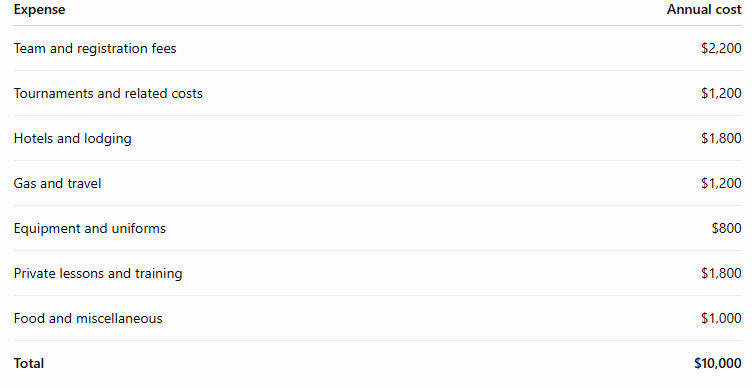
That’s approximately $833 per month.
To be clear, this isn’t the national average. It’s a hypothetical example of what a more expensive travel baseball experience might look like.
According to the Aspen Institute’s Project Play research, families spent an average of $1,016 on their child’s primary sport in 2024.
That figure covers different sports and levels of participation.
But it helps illustrate how dramatically the financial commitment can vary depending on the experience a family chooses.
And it raises a question worth exploring:
What exactly are families investing in when they spend money on youth sports?
The growing business behind youth baseball
Here’s where the story gets especially interesting.
Youth baseball isn’t simply a collection of teams and leagues anymore.
It’s an entire ecosystem of businesses.
Tournament organizers are building competitive events that attract teams from across the country.
Training facilities are giving athletes opportunities to practice year-round.
Private coaches are helping players improve their hitting, pitching, fielding, and overall development.
Equipment companies are introducing new products designed for performance and safety.
Technology startups are changing how athletes train, track progress, share highlights, and connect with opportunities.
And behind many of these businesses are former athletes, coaches, and parents who saw an opportunity to improve the experience.
That’s entrepreneurship in action.
They’re identifying problems, creating solutions, and building businesses around something people genuinely care about.
For Run The Money, that’s a story worth telling.
Because the economics of youth sports aren’t just about what families spend.
They’re also about the people creating jobs, developing products, building communities, and finding new ways to make sports better.
What makes the investment worthwhile?
Of course, families still have to make decisions about their budgets.
And those decisions are deeply personal.
For one family, spending several thousand dollars on travel baseball might represent an extraordinary opportunity.
Their child loves the game. They enjoy the competition. The coaching is excellent. The family values the friendships and experiences.
For another family, the same commitment might simply be too expensive.
Neither family is necessarily making the wrong decision.
The key is understanding what you’re paying for and whether the experience aligns with your family’s priorities.
A good youth sports program might offer:
Quality coaching and meaningful player development.
Appropriate competition that challenges athletes without overwhelming them.
A positive environment that builds confidence and character.
Friendships and experiences that extend beyond the playing field.
Clear communication about costs, expectations, and time commitments.
And sometimes, the best experience is still the local community league where kids play with their friends and parents volunteer to coach.
There’s room for both models.
The college baseball question
One area where I think families benefit from having realistic expectations is the potential pathway to college baseball.
According to NCAA estimates, approximately 8.8% of high school baseball players go on to compete at an NCAA institution, with roughly 2.7% reaching Division I.
And playing college baseball doesn’t necessarily mean receiving an athletic scholarship.
That doesn’t diminish the value of competitive youth sports.
It simply reinforces something important:
The value of playing baseball shouldn’t depend entirely on whether a child eventually earns a scholarship.
There are tremendous benefits to sports participation that never appear on a college recruiting profile.
Discipline. Resilience. Leadership. Physical fitness. Learning how to lose. Learning how to work with people who are different from you.
Those experiences have value regardless of where an athlete’s baseball career ends.
And the best youth sports businesses understand that.
They’re not simply selling the possibility of a scholarship.
They’re helping create experiences and opportunities that matter today.
An opportunity for the industry
As youth sports continues to evolve, I think there’s an enormous opportunity for entrepreneurs who can deliver real value to families.
That might mean more affordable training technology.
It might mean tournament formats that reduce unnecessary travel.
It might mean innovative equipment that makes it easier for kids to practice at home.
Or it might mean building community-centered programs that combine competitive development with accessibility.
The businesses that succeed over the long term will need to earn the trust of families.
And trust comes from delivering on promises, communicating clearly, and understanding what parents and athletes actually need.
There’s an interesting balance here.
Businesses need to be profitable to survive and grow.
Families need to feel that their investments are worthwhile.
And kids need opportunities to enjoy the game.
When those three interests align, everybody benefits.
The bigger picture: Sports, money, and family life
This is why I’m increasingly interested in covering the business of youth sports here at Run The Money.
Because these stories sit at the intersection of so many things that matter.
Family finances.
Entrepreneurship.
Technology.
Community.
Childhood experiences.
And the choices parents make about how to spend their limited time and money.
The $10,000 Little Leaguer isn’t necessarily a cautionary tale.
It’s a window into a much larger economic story.
One that includes passionate families, ambitious young athletes, dedicated coaches, and entrepreneurs building businesses around the games we love.
And I think it’s a story worth following.
Read the full story
I went deeper into the numbers, the business models, and the decisions families face in my original Run The Money article.
The $10,000 Little Leaguer: How Youth Baseball Became Big Business
The article includes a detailed cost breakdown, an interactive season-budget calculator, research on participation and scholarships, and seven questions families can consider before committing to an expensive program.
One question before you go
I’d love to hear from you.
What’s the most valuable thing your family has received from participating in youth sports?

Maybe it’s great coaching. Maybe it’s the friendships. Maybe it’s the competition, or simply the memories you’ve made together.
And if you’re a founder, coach, or entrepreneur building something in the youth sports industry, I’d love to hear your story, too.
Hit reply and tell me about it.
Have a great weekend,
Dave
Run The Money
Run The Money explores the economics of everyday life, including the businesses, people, and financial decisions shaping the sports we love. If you enjoyed this edition, forward it to a parent, coach, or sports entrepreneur.